It was with a thankful and joyous heart that Grace Milner wended her way through the crowded streets of London. She had just been granted her heart’s desire; she had been accepted as a fema-le teacher by a missionary society for the conversion of the Jews, and a life which few, perhaps, would covet, but which to her appeared one of delight, was opening before the clergyman’s orphan. It was a life of independence, and Grace had an honest pleasure in earning her own bread, and having the means even to assist others; it was a life of usefulness, and Grace longed to be able to do some good in the world. And the teacher was young, and of an ardent spirit; to her the very journey offered great attractions: traveling gave her exquisite pleasure, all the grea-ter, perhaps, because she had hitherto seldom enjoyed opportunities of traveling. Grace had not a single relative from whom it would be a pain to part—she stood alone in the world, except so far as she belonged to the family of God. She was full of hope that she might be made a bles-sing where she was going. Grace had a great talent for learning foreign languages, and what to many is a weary task, to her was only an amusement. She felt that she was peculiarly suited for the position in which Providence had placed her, and would not have exchanged her lot for that of any queen in the world.
“Oh! to think of visiting the land in which my Saviour lived and died!” was the reflection of the young teacher as she threaded her way, careless of all that was passing around her; “to think of gazing upon Jerusalem, the guilty, yet sacred city, of standing in the garden of Gethsemane, where the Holy One knelt and prayed! And then to be permitted to lead the little ones of Israel to the footstool of the Saviour! To be surrounded by young descendants of Abraham, to whom I can speak of their fathers’ God! Oh! Sweet command of the risen Saviour, ‘Feed my lambs!’ With what delight shall I obey it, with what delight shall I seek out His jewels, to be my joy and crown of rejoicing when He comes in the clouds with glory! Blessed work to labor for Him! I thank God for the talents which He has given me; I thank Him for the opportunity of spending them all in His service; I thank Him for the hope that I—even I—may one day hear from my Saviour the transporting words, ‘Well done, good and faithful servant, enter thou into the joy of thy Lord.’”
Grace was startled from her dream of happiness by a sudden shock! Absorbed in thought, she had not taken sufficient precaution in crossing a road, and was struck down by a cab that had, unnoticed, turned sharply round the corner of a street.
The young teacher uttered no cry; she fell stunned and senseless to the ground. She saw not the pitying crowd who thronged around her. When raised from the ground, and carried on a shutter to the nearest hospital, she felt no pain from the motion. It was not for some hours that Grace had sufficiently recovered her senses to know what had happened, or to comprehend the nature of the injury which she had received.
Great indeed was the trial to the poor girl when she awoke to a sense of what was before her. Her spine had sustained an incurable injury, such as might not perhaps shorten life, but which might render her utterly helpless as long as that life should last. The once active, energetic yo-ung woman would never again be able even to sit up in bed, and all her hopes of usefulness as a teacher were crushed in a moment for ever!
Dark indeed were the prospects of the orphan, when this cloud of misfortune so suddenly swept over her sky! Where should she go—what should she do—when dismissed, as she soon must be, from the hospital which had received her? Her little savings as a governess had all been expended; she had no home to which to return, no friend wealthy enough to be burdened with the support of a helpless cripple. There was sympathy shown to Grace by the supporters of the charity which had so lately accepted her services. There was even a subscription raised for her; but the assistance thus given was far too small to render the lady independent. As she was unable, and would always be unable, to rise from a lying position, it would be hopeless to attempt to gain a miserable pittance by her needle. Drops of agony stood upon the brow of the poor young lady, as the terrible truth forced itself upon her mind, that, henceforth, the only ho-me that she could look to on earth was the poorhouse.
Grace could not at first bend her spirit to submit to a fate which she looked upon as worse than death. She quitted the hospital for a lodging where the kindness of strangers enabled her to struggle on for a time. But she knew that this could not last; the evil day might be put off, but was certain at length to arrive. Grace thought that it was wrong to draw so heavily upon the charity of others, when so many of her fellow-creatures were in want of common necessaries. What was given to her lessened the power of the generous to assist them; and Grace was of too unselfish a spirit to bear to encroach on the kindness of the rich, or draw away relief from the poor. So she made up her mind at last she would go where she had a right to food and shelter; she would claim the support of her parish, now that she could not support herself.
Deep gloom was upon the soul of poor Grace, when she was carried to the large, dull, cheer-less-looking building, which to her appeared but as a prison. She sank beneath the weight of her cross, and even her religion seemed for a time to bring her no comfort. Satan, ever busy to tempt us, whether in days of wealth or tribulation, was whispering hard thoughts of God. Grace saw in her trial no sign of the love of her Heavenly Father; she thought herself forsaken—forgotten; she longed for death, little conscious at that moment that she was unfit to die!
“Oh! That I should ever be brought down to this!” was her thought, as she was borne across the court-yard of the poorhouse, where a few old women, in pauper’s dress, scarcely turned their heads to observe a new sufferer carried to a place where sickness and sorrow were things too common to attract much notice. “I, well-born, highly educated, degraded to the position of a pauper! Why has God, in whom I trusted, forsaken me? Why has He placed me in a position where I can be but a burden to myself and to others? God gave me talents, and with a willing mind I had devoted all my powers to His service; but now He has taken away the opportunities which once I possessed, of exercising my talents to His glory, and the good of my fellowmen.”
Grace was wrong in three important points: first, She was wrong in thinking herself degraded by becoming a pauper, when she was so not from idleness, nor extravagance, nor any other sin of her own. It was God who had appointed her place, and the post which He assigns to His people must be a post of honor to those who faithfully fill it. Oh! Let the lowly ones of Christ remember this to their comfort! Can poverty be a disgrace when it was the state chosen by the Son of God for Himself, when He deigned to visit the earth? The Lord’s people are kings and priests unto God, heirs of a crown, and inheritors of heaven, whether they dwell in a palace, or lie in a poorhouse ward.
Secondly, Grace was wrong in doubting for one moment the loving care of her God, because He was trying her faith in the heated furnace of affliction. “Whom the Lord loveth he chaste-neth.” Grace had been an earnest and active Christian; but she had little knowledge of the weak-ness and sin of her own heart, till affliction stirred up the quiet waters, and showed her what evil lay below. She had hoped and believed that her will was conformed to the will of God, till sudden misfortune revealed how much of self-pleasing, pride, and unbelief had lurked behind her devotion. Grace now thought herself worse than she had ever thought herself before, only because she now knew herself better; the medicine for pride was most bitter, but it was the hand of love that had mixed it.
And thirdly, Grace was wrong in supposing that all opportunity of glorifying God and of ser-ving others had been taken from her for ever. Never, perhaps, does the Christian’s light shine more brightly, or more profitably, to those who behold it than from the bed of sickness and pain. Wherefore glorify God in the fires! is the watchword for the suffering saint. Happy those who to the words, “We rejoice in hope of the glory of God,” can add, And “not only so but we glory in tribulations also,” knowing that tribulation worketh patience, and patience experience, and experience hope; and hope maketh not ashamed, because the love of God is shed abroad in our hearts by the Holy Ghost which is given unto us!
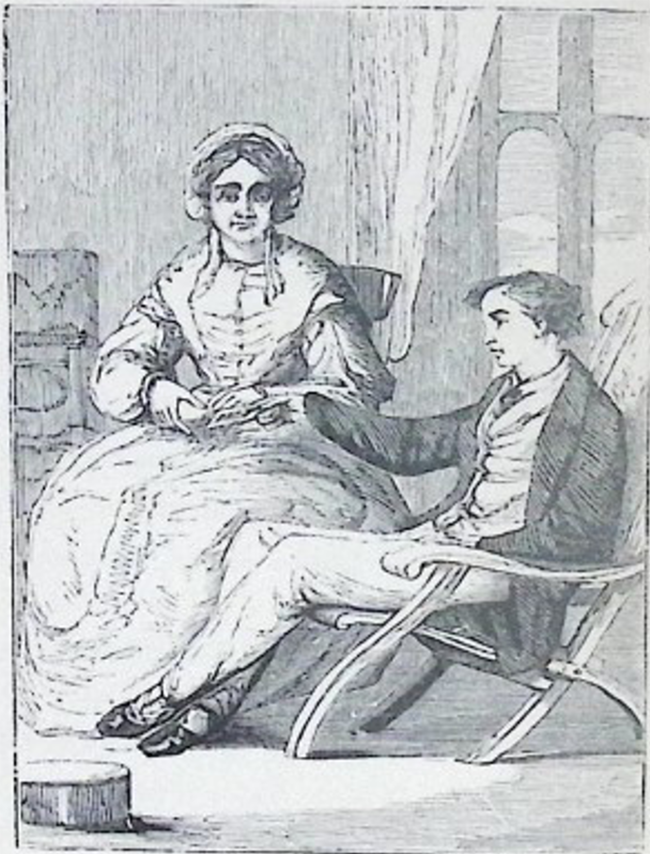
Grace was carried to a ward containing twelve of the aged or sick, and placed on a bed in a cor-ner of the room. The ward was clean and airy, and, in some respects, more comfortable than Grace had been led to expect; but she was little disposed to see in it anything but the dreary as-pect of a prison. She looked with sadness on the bare walls, the high windows—affording no prospect but the sky—and the rows of beds occupied by those with whom she deemed that she would have not a single feeling in common. Grace particularly shrank from the pauper whose bed was next to her own. Ann Rogers, a coarse-looking, red-faced woman, with a rough man-ner and loud voice, which jarred on the nerves of the sufferer.
“Well, poor soul, how came you into your troubles?” were the words with which Ann first add-ressed Grace, standing beside her with her arms akimbo, and surveying the newcomer with a look of mingled curiosity and pity.
Grace flinched like one who had a rough hand laid on a wound, and murmuring a short reply, she closed her eyes in the hope of stopping further conversation.
“You have seen better days, I take it, and so have I. I was cook in a gent’man’s family, I was, and little thought of ever coming to this—.” Ann added an epithet so coarse that I do not choose to repeat it.
“Oh, misery! can I not even suffer in silence?” thought the poor girl. “Must I have that horrible voice for ever dinning in my ears?” Grace said nothing aloud, but her face probably betrayed something of her feelings, for Ann went on in the tone of one who is offended. “There’s no use in anybody’s playing the fine lady here, or turning up her nose at the company she meets with. This ain’t the place for airs, and I’d advise no one to try ‘em upon me!”
The heart of Grace sank within her. Weak as she was, and in constant pain, she needed gentle sympathy, tender care, and perfect quiet; and it appeared that none of these could ever be her own. She had no spirit to bear up against the thousand petty annoyances inseparable from her condition. She resolved that she would never complain, but the resolve, it must be confessed, came as much from pride as from patience. She would shut herself up in her sorrow, and have nothing to do with her companions. In her desponding gloom, Grace forgot that those around her were God’s creatures as well as herself: that they, like herself, were afflicted, and that the command, “Love one another,” is as binding in the poorhouse as in the brightest, happiest ho-me.
The poor lady might long have remained in this miserable state, with her mind suffering still more than her body, impatient, despairing under her cross, unloved, unloving, and desolate; but for a seemingly trifling incident which occurred a few days after her arrival. This was a visit to the ward from a lady who came regularly once a week to read the Bible to its inmates. Mrs. Grant was not gifted with talent: she had little power of influencing others; she could not, like some more honored servants of God, so plead with sinners that the hardened heart should be touched with the holy eloquence of love. She was a plain, quiet woman, somewhat stiff in her manner, who did her duty indeed as unto God, but who in herself was little capable of making any impression on others. Conscious perhaps of her own defects, the lady contented herself with reading the Scripture without making any remarks upon it. The portion which she chose upon this occasion was the parable of the talents. Grace listened in deep depression; the words reminded her so painfully of her own shattered hopes, of her joyous praises on the morning on which her accident had occurred—”I thank God for the talents which He has given me: I thank Him for the opportunity of spending them all in His service.”
But the parable does not end with the account of the “good and faithful servants who entered into the joy of their Lord.’ There is a second part, and it was this which especially fixed the at-tention of Grace as she lay on her couch of pain.
“Then He which had received the one talent, came and said, ‘Lord, I know thee that thou art a hard man, reaping where thou didst not sow, and gathering where thou didst not scatter; and I was afraid, and went away and hid thy talent in the earth: lo, thou hast thine own.’”
“His Lord answered and said unto him, ‘Thou wicked and slothful servant—’” And then fol-lowed the stern but just rebuke, closing with the terrible sentence—”’Cast ye out the unprofitab-le servant into the outer darkness: there shall be the weeping and the gnashing of teeth.’”
The plain, forcible lesson from Scripture went straight to one heart in that ward—a loving, obe-dient heart, that received the truth in simplicity. Grace did not turn from the light, because it showed her a blemish in herself; she did not try to persuade herself that the lesson was meant for some character quite different from her own.
“Is not this God’s message to me,” thought the sufferer; “and is not this warning for me? Would not I have been glad to have been trusted with the ten talents, or the five; but when only one was left to me, did I not, in discontent, despair, bury it deep and hide it? And why, why have I done so? Because I have dared to entertain gloomy ideas of my God. I have thought His dealings hard, and my faith and patience have failed! But have I, indeed, one talent: I who am so feeble that my voice could scarcely reach beyond the bed next to mine? Yes, there is one soul at least in this ward which I might influence for good: there is one at least to whom I ought to show how meekly a Christian can suffer. There is great ignorance which I have made no attempt to enlighten. I have even repelled my fellow-sufferers by coldness that looked like pride. I have been gloomy—perhaps sullen in my grief. Alas! alas! I have buried my talent. God help me to use it ere it be too late!”
In the meantime Mrs. Grant had quitted the ward, and some of the paupers began to make ob-servations upon her.
“I daresay, now that ‘ere lady thinks she has done a mighty good deed in sitting there starched and stiff for ten minutes, and then sweeping away in her rustling silk, without so much as as-king one of us how we be!” said Ann Rogers, in her harsh and insolent tone.
“Yes,” observed the nurse, “she’s different from the lady who visited the ward that I had down below. That lady smiled so kind, and talked so pleasant that it was a real pleasure to see her; and she made everything in the Bible so plain. Then, it seemed as if she really did care for us; she talked to us quietly one by one, and was as sorry for any one sick or in pain as if she had been an old friend. That’s the kind of visitor for me.”
“I knew a lady, afore I came into the house, who allowed a poor old soul as lived in a garret a pound of tea every month, and a sack of coal at Christmas. That’s what I calls a friend,” said Ann Rogers.
“The kindest thing I ever heard of,” observed an old, bedridden pauper, “was a clergyman’s taking in my poor brother, who had chanced to fall down in a fit at his gate, and nursing him, and paying his doctor, and giving him a half-crown and a good warm coat when he left. A real kind Christian was that parson, who knew how to practice what he preached.”
There was a general murmur of assent through the room. When it was silenced, Grace Milner said, in her soft, faint voice, “If you are comparing deeds of kindness, I think that I know of one greater than any that you have mentioned. I do not mean to undervalue the generosity of either the clergyman or the lady; but I could tell you of one who, without spending a farthing, did mo-re than either of the two. My story is a true one, and belongs to the history of the famous gene-ral, Sir David Baird.”
“A story—let’s have that,” said the nurse, who, like most of those in the poorhouse, was glad of anything that gave promise of affording five minutes’ amusement.
“So you’ve found your tongue at last,” observed Ann Rogers, who had been inclined to take offence at the previous silence of the invalid lady.
Grace slightly flushed at the rude remark; but without appearing to take notice of it, and lifting up her heart to God to ask for His blessing on her attempting to use her one talent to His glory, she recounted the following little anecdote, in the hope of drawing from it some spiritual lesson.
“Some seventy or eighty years ago a fierce war raged in India between the English and a native monarch called Tippoo Saib. In the course of this war, which ended at last triumphantly for our country, our troops sustained a terrible disaster, and some of our most gallant officers fell into the enemy’s hands.”
“And mighty little mercy they found, I’ll warrant you,” observed Ann Rogers.
“The officers, amongst whom was Baird, then a young man, were thrown into a horrible prison, where those who had been brought up amidst the comforts of an English home were exposed to hunger and miseries untold. What made their condition yet more wretched was that some of the officers had been wounded—Baird, in particular, had been shot in the leg, and pain and weak-ness were added to confinement, want, and anxious fears for the future. A wild beast was at one time kept near the prison of the unfortunate English, and its howls greatly disturbed them; for a dread arose in their minds that the tyrant Tippoo intended to give his captives as a prey to the savage animal.”
“Poor souls, they were worse off than we,” said the nurse, who had seated herself on the edge of Grace’s bed, to listen to her tale.
“One day the English were further alarmed by a great clanking noise just outside their prison. The door opened, and a number of native smiths came in, bearing a quantity of iron fetters, which they flung down on the floor. The wretched captives too easily guessed who were to wear these chains. A native officer then entered, who gave command that a pair of fetters should be fixed upon the legs of each of the unhappy gentlemen.”
“What! The wounded and all?” exclaimed Ann.
“A gray-haired officer,” continued Grace,—”I grieve that I have forgotten his name—determined to make an effort to save poor Baird from the agony to which he was destined. ‘It is impossible,’ said he to the dark Indian, ‘that you can think of putting chains upon that suffering young man. A bullet has been cut from his leg; his wound is fresh and sore; the chafing of the iron must cost him his life.’ But the heart of the heathen whom he addressed seemed cold and hard as the iron itself. What cared Tippoo’s servant if the prisoner suffered; what cared he if the prisoner died!”
“’There are just as many pairs of fetters as there are captives,’ he said; ‘let what may come of it, every pair must be worn.’”
“’Then,’ said the noble officer, ‘put two on me; I will wear his as well as my own.’”
“Bless him,” exclaimed the nurse, warmly. “That was a friend indeed; and what was the end of the story?”
“The end of the story is that Baird lived to regain his freedom, Jived for victory and reward, lived to besiege and take the very city in which he had so long lain a wretched captive. In the last deadly struggle, Tippoo was slain.”
“And the kind officer?” interrupted Ann.
“The generous friend died in prison,” replied Grace.
“Well,” said the nurse, with a sigh, “he did more indeed than either the clergyman or the lady. To be willing to wear two chains, and all for the sake of his friend!”
“What would you have thought,” asked Grace, “if he had borne the fetters of all in the prison? What would you have thought if instead of being a captive himself, he had been free, and we-althy, and great, and, for the sake of the unhappy sufferers, had quitted a glorious palace to live in their loathsome dungeon, to wear their chains, to bear their stripes, to suffer and die in their stead that the captives might go free?”
“Such a thing would never be done,” cried Ann Rogers.
“Such a thing has been done,” exclaimed Grace. There was a murmur of surprise from her hea-rers; she paused a minute, and went on, clasping her hands as she spoke. “Helpless captives of sin, doomed to wear the heavy chain of God’s wrath, trials in this world, endless woe in the next; such are we all by nature—such would we all have remained, had not the Son of God himself deigned to visit our prison. He bore the weight of all our guilt, He endured the punish-ment which we had deserved; and now, for all who receive His grace, the prison is thrown wide open; victory over sin here, and glory in heaven—such are the blessings bought for His people by the blood of our Lord Jesus Christ.”
“Ah!” observed the nurse, in an undertone, “that’s how my lady used to speak. Many a time has she told me that there’s no friend like the Lord; for there’s no one on earth would do for us what He did of His own free will.”
Grace felt joyful surprise on finding that there was some one in the ward who looked to the blessed Saviour. An ignorant but simple-minded Christian was near her, ready and glad to be instructed; and the lady reproached herself for having ever thought that her own work for God was ended.
“Well,” observed Ann, in her blunt manner, “I went to school when I was young, and I learned a good deal of the Bible there, which I’ve not all forgotten yet. I know that the Lord died for us, and that, when we’ve done with the troubles of this life, we shall go and be happy in heaven.”
Grace had already heard enough of the bad language, and seen enough of the bad temper of this woman, to fear that Ann was deceiving herself; believing her soul to be safe, although she had never yet repented of sin, or struggled against its power; never yet given her heart to the Lord. Oh! Fearful mistake of multitudes deceived by Satan, who, because salvation’s stream flows within their reach, believe that its blessings are theirs, though they never have tasted of its waters. Grace felt that the conscience of Ann was asleep, and she silently prayed that God might awaken it.
“Suppose that the generous officer during his captivity,” said Grace, “had called Baird to his side, had entreated him to do something for his sake whenever he should quit the prison; sup-pose that, when Baird was free, and rich, and happy, he had totally forgotten his friend, had quite neglected his dying wish, and had even done dishonor to his name, what should we think of such conduct?”
“Think,” exclaimed the indignant nurse, “we should think it shamefully ungrateful.”
“The world’s bad enough, I take it,” cried Ann; “but there’s none of us bad enough to neglect the dying wish of a friend like that.”
“Ah! let us take heed that our own words condemn us not,” faltered Grace. “We have seen that the love of the Saviour to us has exceeded all other love; has not our ingratitude to Him excee-ded all ingratitude beside? On the very night before He suffered, did not the Lord utter the words, ‘If ye love me, keep my commandments?’ And how has that dying charge been fulfilled? Have we not, at least too many of us, quite forgotten the Saviour? Have not our hearts been as cold and dead, our conduct as careless and sinful as if we had never known His love, or heard of His holy commandments?”
“Well, well, we all go wrong sometimes; but the Lord won’t judge his poor servants,” said Ann, in a tone which seemed to say, “Let’s have no more of this preaching.”
But the heart of the heathen whom he addressed
seemed cold and hard as the iron itself. What cared Tippoo’s servant
if the prisoner suffered, what cared he if he died?
“If we be His servants!” exclaimed Grace, with earnestness, “but let us not forget that God’s Word declares, that ‘if any man have not the Spirit of Christ, he is none of His’; yea, the Lord Himself hath said, ‘He that is not with me is against me; no man can serve two masters,’—if we be not heartily upon the Saviour’s side, we are upon the side of the world and Satan.”
“It’s just like this, I take it,” said the nurse, “it’s just as if Baird had chosen to forget all about his country and his duty, and had gone into the service of Tippoo, and had even fought in his cau-se.”
“He’d have been a vile rebel,” cried Ann.
“And have been punished as such,” observed Grace. “What would have been to him the name of Englishman? It could only have increased his shame; and what to us will be the name of Christians, if we are found in the ranks of Christ’s foes? Oh, let us pray that we may be of the number of those who are saved from wrath by His death, and freed from sin’s prison by His grace, and who bravely fight in His cause against the world, the flesh, and the devil! To such the victory is certain, to such the crown is sure; we shall be ‘more than conquerors through Him who loved and gave Himself for us.’”
Grace ceased, for her strength was exhausted; but a feeling of peace and hope, such as she had not known before since her accident, stole over the lady’s soul. She felt that she had done what she could; however little that might be, and that the Lord would not despise the one talent which she sought to lay out for Him. Grace sank into refreshing sleep, with the promise sounding in her ears, “They that be wise shall shine as the brightness of the firmament, and they that turn many to righteousness as the stars for ever and ever.”