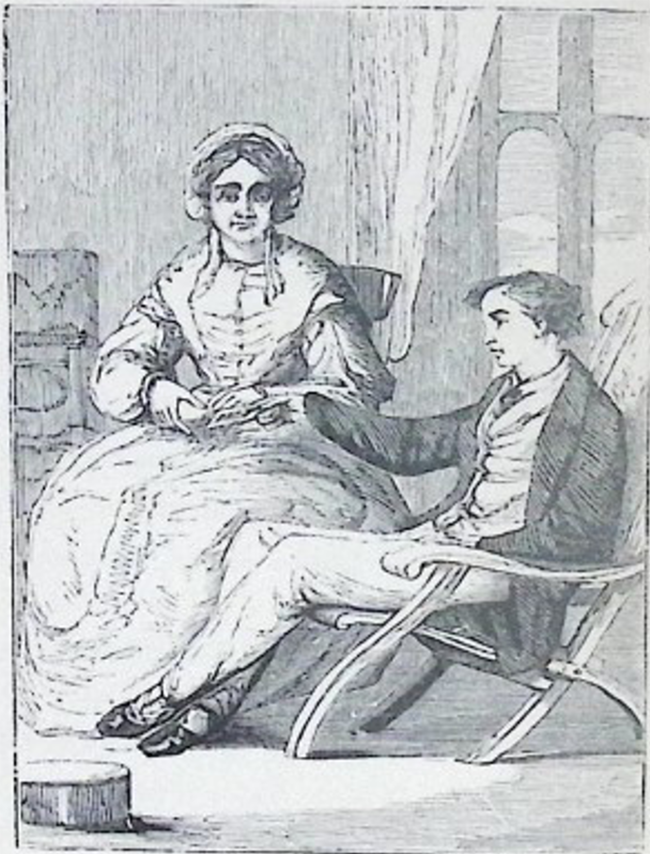
REBECCA BURTON and Lydia White sat chatting over their tea. They were near neighbours, for they dwelt opposite to each other; and Rebecca, who earned her living by going out washing and charing, and had but a lonely time of it during the long winter evenings, was often invited by kind Widow White to share a meal with her and her little daughter Agnes. Not that Rebecca was one whose society gave much pleasure to her friend: she was a bustling, gossiping woman, very full of her neighbours’ concerns. Where there is little thinking, there is apt to be much talking; it has been well said that only empty bottles are never corked up.
Little Agnes, with her large black attentive eyes, sat perched on a high chair beside her mother, listening to every word that was spoken, and not a little amused by Rebecca’s idle gossip. While slice after slice of buttered toast and tea-cake were despatched, cup after cup of good black tea poured from the shining tea-pot, the guest talked as eagerly and as fast, as if talking were “the business of life.”
“Well, Mrs. White,” said Rebecca, helping herself for the third time from the well-filled plate, “I think that you’ve always had a bit of a fancy for that Mrs. Miles, but she’s not a person to my mind. Would you believe it now, when the subscription went round for the poor weavers,—and even I, hard up as I often am, could manage to drop a bit of silver into the plate,—Mrs. Miles was not ashamed to put in only a penny! And she with a house and shop of her own! I’m sure, if I’d been she, I’d a deal rather have given nothing at all!”
“What a mean creature Mrs. Miles must be,” thought little Agnes to herself.
“Perhaps,” said Mrs. White in her quiet tone, “you do not know that for the last year Mary Miles has been struggling hard to pay the debts brought on by her husband’s long illness. She, no doubt, feels it her duty to be just before she is generous, and however willing to give much, knows that it would not be honest to do so.”
“Oh, but think of the look of the thing!” exclaimed Rebecca; “who was to know of her debts? But Mrs. Miles,—she’s an odd woman,” continued the charwoman, lowering her voice, though not sufficiently so to prevent every word being heard by Agnes: “though people say she’s so good, I take it she’s not all that folk fancy her to be. You think it right to go to church regularly, don’t you? I often see you there with your little girl.”
“Mother always goes to church,” exclaimed Agnes, “even if it is raining ever so hard!”
“That’s right,” said Rebecca, approvingly; “it always looks well when one is never missed from one’s place in church. But I’ve noticed that Mrs. Miles has kept away these last two Sundays, and I know that she has not been ill, for I’ve seen her on week-days serving in the shop. Even if she don’t care for religion, I wonder that she don’t attend steadily, if but for the look of the thing.”
“Mrs. Miles goes to church for something better than the look of the thing,” said the widow, with a quiet smile; “I am so glad that you mentioned the subject to me, that I may be able to set you right. These last two Sunday mornings have been spent by Mary Miles in nursing poor sick Annie Norris, that her daughter may go to church; and then, in the evening, Mary herself attends a place of worship with her husband. I think it a privilege to go to the house of prayer, but I believe that Mary Miles is doing her Master’s work just as truly while nursing a poor sick neighbour, reading the Bible to her, and giving up her Sunday rest that another may be able to enjoy it,—as if she attended every service in the church.”
“Ah, well,” exclaimed Rebecca, half impatiently, “you are always one to find excuses; you’re ready enough to stand up for your friends! Another drop of tea, if you please,” and she pushed her cup across the table. Then, turning towards little Agnes, she said, in a different tone, “You must come and pay me a visit some day, my dear,—I have something to show you worth the seeing. I’ve been subscribing for a long long while to the Illustrated Bible, and with some money which I got as a Christmas box, I’ve had the numbers bound together into such a beauty of a book. But I dare say that your mother has done the same,—she’s one to honour the Bible, as all know. Whenever one sees a large handsome Bible in a parlour, to my mind it’s a kind of sign of the respectability of the people in it. None of your nick-nacks, say I; give me a well-bound Bible, with shining edges and gilded cover!” and Rebecca, proud of owning such a volume, sipped her tea with an air of the utmost self-satisfaction.
“Mother,” said little Agnes, “your Bible is very old,—it has not a bit of gilding upon it, Could we not buy a new one?”
“My old Bible is more precious to me,” said Mrs. White, “than any new one could be. It belonged to my own dear mother.”
“It is shabby, though,” observed Rebecca, glancing at the plain black volume which lay on a shelf; “you might any ways have it new bound,—you should think of the look of the thing.”
“It is in good repair,” said Mrs. White; “I am quite contented with my Bible as it is.”
Rebecca gave a little meaning nod of her head, as if to say, “I care more for the Bible than you do, though everybody thinks you a saint.”
Nothing more, however, passed on the subject; and the guest soon afterwards took her departure.
Agnes, with her thoughtful black eyes fixed upon the old Bible, sat for a while in silence, turning over in her young mind the conversation that had passed between her mother and their neighbour.
“What is my quiet little lassie dreaming about?” asked Mrs. White, who was clearing away the tea things.
“Mother,” replied Agnes slowly, “I was thinking over what Rebecca Burton said about Mrs. Miles, and your Bible which looks so old. You and she didn’t seem to feel alike. Is it not right, dear mother, to care for the look of the thing?”
“It is right to care something for appearances, but a great deal more for realities,” quietly observed Mrs. White.
“I do not understand you at all,” said Agnes; “is it not a good thing, mother, to give to the poor, to go to church; and to honour the Holy Bible?”
“A very good thing, my child, if done not to win the praise of men, but from the motive of love to God.”
“I do not know what ‘motive’ means,” said Agnes.
“It is the spring or cause of our actions. Two persons may give exactly the same sum to help a poor creature in great distress. One gives her shilling for the look of the thing, because she wishes the world to think her generous; the other gives it for the love of God, and so that He accept her offering, cares not if her gift be known by not one being on earth. You must see that the motive of the second is piety, the motive of the first is pride. Both women do the same thing, but one does it to please God, while her neighbour only pleases herself.”
“But so long as the money is given,” said Agnes, “I don’t see that the motive matters very much.”
“It matters everything,” observed Mrs. White, “in the eyes of Him who readeth the heart. The cause of so much self-righteousness in the world is this: people, respectable people I mean, count up all their own kind actions, and never take the trouble of searching into their motives at all. How few would say to themselves, ‘I am honest indeed, but only because I have found that the honest thrive best in the end;’ ‘I go to church regularly, but only because it is thought a respectable thing to do so;’ ‘I give freely, but only because I could not bear my neighbours to call me mean;’ ‘I pay what I owe, but only because if I did not, no one would trust me again.’”
“Do you not see, my child, that in all this the love of God is not the motive? If as much gain, and respect, and praise could be had by breaking God’s laws as by keeping them, those who now do good deeds to be seen of men, would do evil ones in their stead.”
Perhaps little Agnes was growing sleepy, for Mrs. White could not help perceiving that the child did not follow her argument. The mother did not try to explain herself further; she waited for some opportunity of making her little daughter understand more clearly the truth which was so plain to herself.
On the following morning Agnes came running up to her mother with a look of delight. “See, see!” she exclaimed, “What a beautiful watch my uncle has given me!” and she held up for the widow’s admiration a very pretty toy watch! “It looks just as well as yours, mother, indeed I think it much the prettier of the two. Just see,—it has a chain, and seals, and a nice shining face, with all the hours marked on it, and slender little bright hands that I can move to any part with my key! Is not my little watch just as good as yours, mother?”
“As far as the look of the thing goes, yes, my dear,” replied the smiling parent.
“There’s hardly any difference between them,” said Agnes; “only mine looks a little the brighter, because, you know, it is new. Please tell me the time, the exact time, that I may set my watch right.”
“A quarter of ten,” said Mrs. White.
With pride and pleasure little Agnes turned the hands, till they pointed just to the hour. It was almost time for her to set off for school, which she did in very high glee, showing to all the companions whom she met the beautiful present of her uncle.
“I am back a little earlier than usual, am I not, mother?” were the first words of Agnes White, when she returned from morning school. “Oh, you need not look at your watch,—you know I have now a watch of my own!” Agnes pulled out her bright little toy, and there were the hands exactly where she had placed them, pointing to a quarter of ten!
“Did you expect them to move, when there was no mainspring inside?” asked the widow with a smile.
Agnes scarcely knew whether to look vexed or amused. “I was a stupid little girl to fancy that they would move,” said she; “mine is a very pretty watch, but it is only good to be looked at,” and she laid it down on the table with an air of disappointment.
“Ah, my child,” said Lydia White, gently drawing her little daughter towards her; “is not the watch without springs like that of which we were yesterday speaking, good conduct without a good motive? The most precious part of a real watch is that part which is unseen; and in like manner, it is the hidden motive for any good act which alone can give it true value.”
“But ought we never to care how our conduct appears?” asked the child.
“Yes, my Agnes,” replied her mother, “for those who have been bought with a price, even the precious blood of God’s dear Son, are called to glorify their heavenly Master both with their bodies and their souls. We are called so to live that the world may say, ‘There must be power in religion, for none are so honest, so true, so kind as those who are servants of God.’”
“I don’t quite understand,” said Agnes.
“Look again, dear child, at my watch, it may help to make the subject clearer. You know that the watch is a good one, you know that the mainspring is right.”
Agnes nodded her head.
“How is it that you know?” asked her mother.
“The hands always point to the right place,” replied Agnes; “they go just the same as the church clock.”
“But suppose that we pull off the hands,” said the widow.
“O mother, that would be a pity,—you never would do such a thing! If the hands were off, you might, wind up the watch, and the watch might go, but it would be of no use to others.”
“Nor would it, do honour to its maker, my child. Now turn front the watch to the subject which I am trying to explain by its means. If the motive of love to God be like the mainspring to a Christian, the cause of all his good actions, his outward conduct is like the hands whose steady movements show that the mainspring is within. If they are constantly right, we believe that the hidden wheels are right, we know that the watch has been wisely made, carefully regulated, daily wound up. So when the Christian quietly goes on his circle of duties, ever seeking, by the help of God’s grace, to do the will of his Lord,—he shows to the world a living example of the power and truth of religion; he does good not for the look of the thing, but because the love of Christ constraineth him to act as conscience directs.
“And then others, seeing the good example, may be led to follow it,” observed Agnes, upon whose mind the meaning of her mother was now dawning.
“It is a common saying, Agnes, that ‘example is better than precept,’” observed Mrs. White. “If we must search carefully into our motives for the sake of our own souls, we must also be watchful over our conduct, for others’ sakes as well as our own. Never can we too earnestly study, too carefully follow the Saviour’s command which refers to the outward behaviour of those who have the hidden motive of love,—’Ye are the light of the world. A city that is set on a hill cannot be hid. Let your light so shine before men that they may see your good works, and glorify your Father which is in heaven.’ (Matt. v. 14, 16.)”