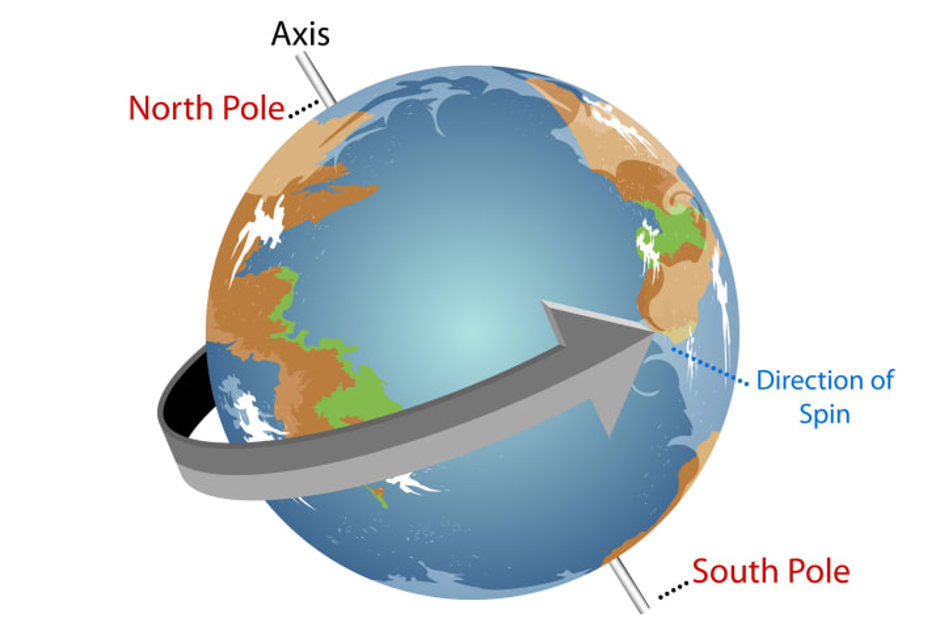
Did you know that the Earth is always spinning? This spinning motion is called rotation. Imagine the Earth as a giant top, turning around and around!
What is rotation? Rotation is when something spins or turns around a central point. Just like a spinning top, the Earth spins around an imaginary line called its axis. The Earth’s axis is like an invisible line that runs from the North Pole to the South Pole.
How long does it take for the Earth to rotate? It takes the Earth about 24 hours to make one complete rotation. This means that every day, the Earth spins all the way around once. That’s why we have day and night!
What causes day and night? As the Earth rotates, different parts of it face towards or away from the Sun. When your part of the Earth is facing the Sun, it’s daytime. But when your part of the Earth is facing away from the Sun, it’s nighttime. That’s why we have day and night!
What direction does the Earth rotate? The Earth rotates from west to east. If you imagine looking down at the North Pole, the Earth spins in a counterclockwise direction.
Does the Earth’s rotation affect us? Yes, the Earth’s rotation affects us in many ways! It helps create day and night, affects the weather, and even influences the ocean tides. Without the Earth’s rotation, life as we know it wouldn’t be possible!
Test 32
1. What is rotation?
A) When something moves up and down.
B) When something spins or turns around a central point.
C) When something floats in the air.
D) When something grows bigger.
2. How long does it take for the Earth to make one complete rotation?
A) 12 hours
B) 24 hours
C) 48 hours
D) 365 days
3. What causes day and night?
A) The Earth’s rotation
B) The Moon’s rotation
C) The Earth’s orbit around the Sun
D) The Earth’s tilt
4. In which direction does the Earth rotate?
A) North to South
B) East to West
C) South to North
D) West to East
5. How does the Earth’s rotation affect us?
A) It makes the Earth bigger.
B) It creates earthquakes.
C) It helps create day and night.
D) It causes the seasons to change.
6. Where is the Earth’s axis?
A) From the East Pole to the West Pole
B) From the South Pole to the North Pole
C) From the North Pole to the South Pole
D) From the West Pole to the East Pole